News

How to Reduce Deep Groove Ball Bearing Noise and Vibration

2026-09-30 0 Leave me a message

Unusual noise from a deep groove ball bearing is rarely “just how it sounds.” A growling, squealing, or humming noise almost always points to insufficient lubrication, poor alignment, or an early-stage mechanical fault. For engineers working on electric motors, home appliances, robots, and precision instruments, understanding what causes deep groove ball bearing noise and vibration — and how to fix it — has become a core competency rather than a niche concern.

This article examines the root causes, engineering countermeasures, and new industry standards shaping how the bearing sector addresses NVH performance in 2026.

Quick summary: Noise and vibration in Deep Groove Ball Bearings usually come from five sources — raceway waviness, ball errors, cage vibration, lubrication problems, and mounting misalignment. Fixing them requires a system-level approach, not a single part swap.

What Causes Noise and Vibration in Deep Groove Ball Bearings?

Deep groove ball bearings generate vibration from multiple sources simultaneously, which is why a single fix rarely solves the problem. Researchers studying low-noise bearing design have identified five primary contributors: raceway waviness, rolling element (ball) errors, cage vibration, inadequate lubrication, and assembly misalignment.

Among these, raceway waviness — microscopic geometric irregularities on the race surface — is one of the most persistent. It directly causes operational vibration with consequences for power losses, noise, and fatigue life. Even microscopic imperfections in the bearing raceway can translate into audible noise at high RPMs and accelerate wear over time.

Cage vibration is another frequently overlooked source. The stamped steel cages used in many deep groove ball bearings are relatively thin with low bending stiffness in both radial and axial planes. At high rotational speeds, they can undergo self-excited vibration caused by bending deformation, producing a characteristic “buzzing” sound.

Lubrication-related issues are especially significant. The grease inside a bearing affects not just friction and wear but also noise, vibration, operating temperature, and speed capability. Incompatible grease, insufficient fill volume, or contaminated lubricant can all generate distinct noise signatures.

Finally, installation errors and shaft-housing misalignment remain widespread. Hammering a bearing during mounting, ignoring shaft and housing tolerances, or failing to ensure proper alignment can damage raceways and introduce vibration that no bearing redesign can overcome.

Key point: Noise is a symptom, not a cause. Before changing the bearing, check lubrication, clearance, alignment, and installation method — these account for the majority of NVH complaints in the field.

Engineering Countermeasures: From Material to Assembly

Reducing deep groove ball bearing noise and vibration requires a systematic approach that addresses design, manufacturing, and installation. Leading manufacturers have demonstrated measurable improvements through targeted engineering.

Raceway Super-Finishing

Optimizing raceway surface finish is among the most effective noise-reduction strategies. By using three-dimensional analysis technology to refine raceway surface properties — achieving a mirror-like finish — manufacturers can reduce sound pressure in the frequency range that the human ear is most sensitive to, roughly 1,000–5,000 Hz. JTEKT (Koyo Bearings) reported a 5 dB reduction in the perceptually unpleasant frequency band compared to previous models through this approach.

The same principle applies at the manufacturing level. Improving raceway roundness and surface finish has been shown to significantly lower bearing noise in controlled tests.

Acoustic-Grade Lubrication

Lubricant selection is often treated as an afterthought, yet it directly determines noise performance. A case study involving a smart appliance manufacturer demonstrated that switching from standard grease to a noise-dampening synthetic lubricant designed for high-speed operation reduced overall motor noise by nearly 4 decibels — a substantial difference in human auditory perception.

Austrian manufacturer NKE Austria developed a bearing range (NKE POP) specifically for low running noise by using a new lubricant type that simultaneously minimizes starting torque even at low operating temperatures, with a service life covering -50°C to +150°C.

Cage Design Optimization

For applications where cage vibration produces the characteristic buzzing sound, alternative cage materials can help. Polyamide resin cages are commonly selected for high-speed applications because they offer reduced friction and more even lubricant distribution compared to standard pressed steel cages. Optimizing cage structure and material selection is a direct countermeasure against self-excited vibration at high speeds.

Internal Clearance Optimization

Fine-tuning radial internal clearance ensures the bearing remains stable under thermal expansion during prolonged operation. A manufacturer working on a robotic vacuum application found that optimizing internal clearance — combined with raceway finishing and acoustic lubrication — ensured the bearing remained perfectly stable even as the motor heated up during extended cleaning cycles.

Sealing and Contamination Control

Contamination is both a cause and an amplifier of bearing noise. When dust, debris, or fibers enter a bearing, they cause unstable movement of rolling elements and accelerate raceway wear. New sealing technologies address this directly: a utility model patent granted in 2026 (CN224396947U) describes a sealed noise-reduction structure for air conditioner fan bearings that combines sound-absorbing material with a sealing ring. The sound-absorbing material efficiently absorbs mechanical vibration and noise energy while the sealing ring blocks external impurities, preventing wear between balls and raceway.

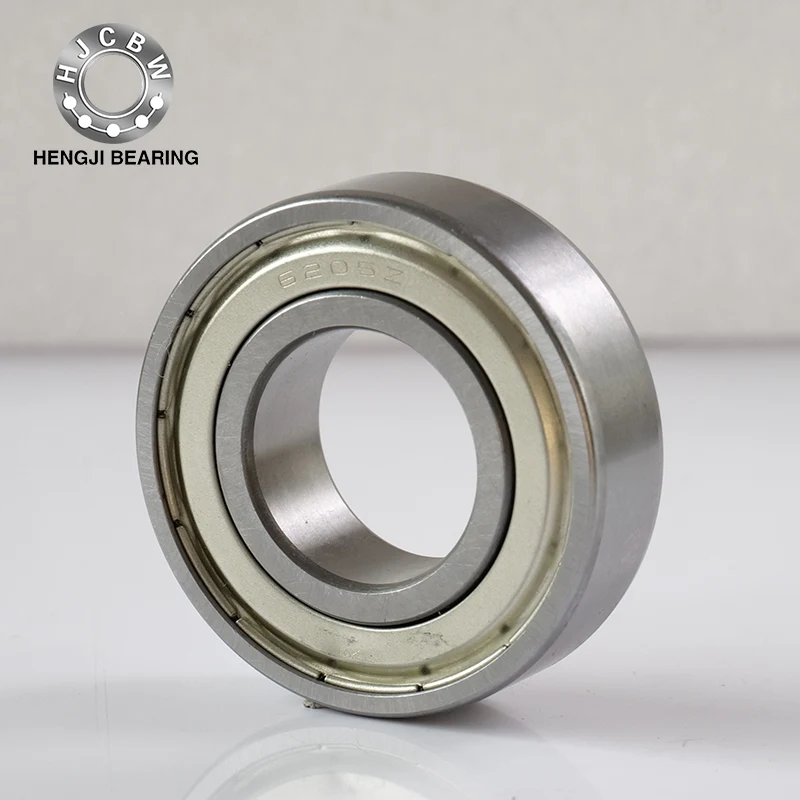
Similarly, NKE’s POP bearing range features double-lip labyrinth seals that provide better contamination protection and improved grease retention despite low friction. For applications where contamination protection is the priority, Deep Groove Ball Bearings with Seal are often the better choice; where higher speed and lower friction matter more, Deep Groove Ball Bearings with Shield may be more suitable.

Noise Source Typical Symptom Practical Countermeasure
Raceway waviness High-frequency hum Super-finishing, tighter roundness control
Ball surface errors Rumbling, rough sound Higher ball grade, vibration-tested steel balls
Cage vibration Buzzing at high speed Polyamide or brass cage, optimized cage structure
Lubrication issues Growling, squealing Acoustic-grade grease, correct fill volume
Mounting misalignment Irregular vibration, heat Proper tools, alignment checks, clean handling

New Industry Standards Reshape Bearing Vibration Requirements

The regulatory landscape for bearing vibration is undergoing significant change. On August 17, 2026, China’s Ministry of Industry and Information Technology approved seven new rolling bearing industry standards, effective March 1, 2027.

Among the most relevant to deep groove ball bearing applications is JB/T 15676—2026, which specifies technical requirements for vibration (velocity) performance of commercial steel balls used in ball bearings. It applies to steel balls with nominal diameters from 3 mm to 31 mm, tolerance grades G20 or higher, and provides technical guidance for improving steel ball quality consistency and reducing bearing vibration during operation. Since ball quality directly influences the vibration signature of deep groove ball bearings, this standard represents a meaningful step toward more consistent noise performance across the supply chain.

A separate standard, JB/T 8922—2026, updates the technical specification for vibration (velocity) of cylindrical roller bearings, replacing the 2011 version. Together, these standards signal that vibration performance is transitioning from a competitive differentiator to a baseline manufacturing requirement.

Compliance note: JB/T 15676—2026 and JB/T 8922—2026 take effect on March 1, 2027. Teams specifying bearings for long-life industrial and appliance programs should review their steel ball and vibration requirements well before that date.

Case Study: 4 dB Reduction in Smart Appliance Application

A smart appliance manufacturer was developing a premium robotic vacuum whose brushless DC motor produced a high-frequency hum that vibrated through the plastic housing and failed acoustic testing. The root cause was traced to micro-vibrations from standard deep groove ball bearings used in the motor assembly.

The bearing supplier’s engineering team addressed the problem through three coordinated adjustments: precision raceway super-finishing to eliminate microscopic friction points; acoustic-grade synthetic lubrication designed for high-speed operation; and optimized internal clearance to maintain stability as the motor heated during prolonged cleaning cycles. The result was an overall motor noise reduction of nearly 4 decibels and a 30% increase in operational lifespan, attributed to reduced vibration and wear across the mechanical assembly.

Trends: NVH Performance in EV and Robotics Applications

Noise and vibration requirements for deep groove ball bearings are tightening across multiple industries.

  • Electric vehicles. Without the masking effect of engine noise, high-frequency noise from electric drive units becomes more noticeable and potentially more annoying to occupants. Researchers at Hyundai Mobis recently published a multibody dynamics study examining how wave washers (used to apply preload to motor bearings) and spline pitch errors affect NVH performance in EV drive motor shaft systems. The findings are expected to contribute to improved NVH performance in electric vehicles.
  • Robotics and human-adjacent applications. As robots move into caregiving and collaborative environments, the demand for “quiet, non-irritating rotation” — what Japanese manufacturers call kansai hinshitsu, or sensory quality — has intensified. This has driven development of bearings with optimized sound output, evaluated not just by conventional vibration metrics but by loudness indices that reflect human perception.
  • Advanced diagnostics. On the condition-monitoring side, new algorithms are enabling earlier detection of bearing faults that generate excessive vibration. A 2026 study published in Advances in Mechanical Engineering proposed a hybrid diagnostic framework combining optimized sparse maximum harmonic-to-noise ratio deconvolution with multipoint optimal minimum entropy deconvolution. The method effectively suppresses residual impacts and noise, enabling clear recovery of fault characteristic frequencies even under strong background noise conditions.

For space-constrained or precision-driven designs, related product families such as Thin Section Bearings and Non-standard Bearings can also help meet stricter NVH targets when standard catalog parts are not sufficient. Supporting components such as Bearing Accessories also play a role in maintaining stable running conditions over time.

Practical Checklist for Reducing Deep Groove Ball Bearing Noise

For teams working to reduce noise and vibration in deep groove ball bearing applications, the following steps represent a practical starting point:

  • Specify raceway surface finish requirements when sourcing bearings, rather than accepting standard commercial finish.
  • Select lubricant by application, considering speed, temperature range, noise limits, and contamination exposure — not just cost per kilogram.
  • Evaluate cage options for high-speed applications; polyamide or brass cages may outperform standard steel in NVH-critical designs.
  • Specify internal clearance based on actual fit, temperature differential, and speed conditions.
  • Review sealing strategy to balance contamination protection against friction and heat generation.
  • Verify installation procedures including proper tools (induction heaters, hydraulic presses), alignment checks, and contamination control during mounting.
  • Monitor new standards such as JB/T 15676—2026 for steel ball vibration requirements that will take effect in March 2027.
Remember: Most NVH problems are not solved by replacing the bearing alone. Lubrication, clearance, cage design, sealing, and installation method must be reviewed together as a system.

For applications requiring customized solutions, exploring options such as Deep Groove Ball Bearings, Deep Groove Ball Bearings with Seal, and Deep Groove Ball Bearings with Shield can help match the bearing specification to the acoustic requirements of the application. Technical documentation and resources are available through Download, and specific engineering questions can be directed to the team through Contact Us. More industry updates are published under News and the full product range can be browsed at Products.

Frequently Asked Questions

Q1: What is the most common cause of deep groove ball bearing noise?

Inadequate or incorrect lubrication is the most frequently identified cause. Grease with insufficient viscosity, wrong base oil type, or incompatible additives can produce growling, squealing, or humming sounds. Raceway waviness and cage vibration are also significant contributors, particularly at high speeds.

Q2: Can changing the grease really reduce bearing noise?

Yes. Acoustic-grade synthetic lubricants specifically designed for high-speed operation have been shown to reduce overall motor noise by nearly 4 decibels in controlled testing — a perceptible improvement in human auditory terms.

Q3: How does raceway surface finish affect vibration?

Raceway waviness — microscopic geometric irregularities — directly causes operational vibration that impacts noise, power losses, and fatigue life. Super-finishing to a mirror-like surface removes the friction points that generate high-frequency vibrations.

Q4: What new standards address bearing vibration in 2026?

China’s MIIT approved JB/T 15676—2026 (steel ball vibration velocity) and JB/T 8922—2026 (cylindrical roller bearing vibration), both effective March 1, 2027. JB/T 15676—2026 specifically targets steel ball quality consistency to reduce bearing vibration.

Q5: Why is NVH more critical in electric vehicles?

Without engine noise to mask high-frequency sounds, electric drive unit noise becomes more noticeable and potentially more irritating to occupants. Bearing preload variation and shaft coupling errors — such as spline pitch errors — significantly affect NVH performance in EV drivetrains.

Q6: Can cage design affect bearing noise?

Yes. Stamped steel cages in deep groove ball bearings can undergo self-excited vibration at high speeds due to low bending stiffness, producing a buzzing sound. Polyamide resin cages offer reduced friction and more even lubricant distribution for high-speed applications.

Related News
Leave me a message
X
We use cookies to offer you a better browsing experience, analyze site traffic and personalize content. By using this site, you agree to our use of cookies. Privacy Policy
RejectAccept